


GENERAL INFORMATION ABOUT AUSTRALIA
Saturday - 29/11/2025
See the full information about Australia: Here
Australia, officially the Commonwealth of Australia, is a country comprising the mainland of the Australian continent, the island of Tasmania and numerous smaller islands. It has a total area of 7,688,287 km2 (2,968,464 sq mi), making it the sixth-largest country in the world and the largest in Oceania. Australia is the world’s flattest and driest inhabited continent. It is a megadiverse country, and its size gives it a wide variety of landscapes and climates including deserts in the interior and tropical rainforests along the coast.
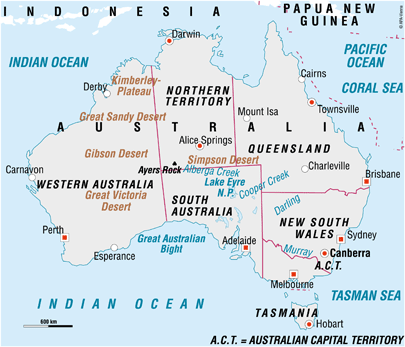
Map of Australia by States and Territories
Indigenous Australians are believed to have lived on the continent for at least 40,000 years before the first British settlement in the 18th century. Indigenous people spoke hundreds of languages, grouped into roughly 250 language families. Dutch explorers first sighted the continent in 1606, and Britain later claimed sovereignty over the eastern half of Australia in 1770, initially establishing the colony of New South Wales as a penal settlement before 26 January 1788.
Population grew steadily over the following decades; the continent was gradually explored, and five additional British colonies were established. These later became Australia’s six states (New South Wales, Victoria, South Australia, Western Australia, Tasmania, and Queensland) and two territories (Northern Territory and the Australian Capital Territory).
On 1 January 1901, the states and territories federated to form the Commonwealth of Australia. Since then, Australia has maintained a stable liberal democratic political system. The Federation consists of six states and several territories.
Australia’s population is 23.1 million, with a high level of urbanization concentrated mainly in the eastern states.
Australia is a highly developed country and one of the world’s most prosperous nations, with the 12th largest economy globally. In 2012, Australia ranked 5th worldwide in GDP per capita. Its military expenditure ranks 13th globally. Australia also has the second-highest Human Development Index (HDI) and performs strongly across international measures such as quality of life, healthcare, education, economic freedom, and protection of civil and political liberties.
Australia is a member of the United Nations, G20, the Commonwealth of Nations, ANZUS, OECD, WTO, APEC, and the Pacific Islands Forum.
Key Facts:
- Capital: Canberra
- Country Code: +61
- Area: 7,692,000 km²
- Population: 25.69 million (2023)
- Official Language: English
- Government: Bicameral parliamentary system
- Historical Development: Since the 1700s
Additional Information:
If you need assistance, contact us here.
Duc Anh EduConnect
Hotline: 09887 09698, 09630 49860
Email: duhoc@ducanh.edu.vn
Website: ducanhduhoc.vn/
Related article

SCHOLARSHIPS FOR STUDYING IN SINGAPORE
Singapore offers a wide range of scholarship opportunities designed to support international students at all academic levels, from associate degrees to postgraduate programs. These scholarships not only help reduce financial…
SINGAPORE STUDENT VISA
Student visa procedures for Singapore are simple and efficient. Students who wish to study in Singapore must be in good health, have good character, possess sufficient financial ability to support…
APPLIANCE FOR STUDYING IN SINGAPORE
Vietnamese students commonly apply to study in Singapore across all levels – from primary and secondary school to diploma, bachelor’s, master’s, and doctoral programs. Students may enroll in any type…
UNIVERSITIES IN SINGAPORE
Universities in Singapore offer a full range of academic programs, including bachelor’s, master’s, and doctoral degrees. There are three types of universities in Singapore: Public Universities Private Universities Foreign Universities…
COLLEGES IN SINGAPORE
Colleges in Singapore offer vocational and professional training programs, and students may study at either public or private institutions. Graduates from diploma programs can enter the workforce immediately or continue…
SINGAPORE PRIMARY AND SECONDARY SCHOOLS
General education in Singapore is governed directly by the Singapore Ministry of Education and is divided into three levels: primary, secondary, and junior college. Schools include public, private, and international…