









EDUCATION SYSTEM IN FRANCE
Thứ Hai - 15/12/2025
The French education system is divided into three levels:
- Primary Education (l’enseignement primaire) – 9 years, of which 8 years are compulsory
- Secondary Education (l’enseignement secondaire) – 7 years
- Higher Education (l’enseignement supérieur) – 2 to 8 years
In 1882, Jules Ferry, then Minister of Education, implemented a law requiring all children aged 6 to 12 to attend school regardless of gender, race, religion, or ethnicity, and education at this level was made completely free. Since 1959, schooling has been compulsory for all children aged 6 to 16, and from September 2019, compulsory education begins at age 3.
All academic programs in France are supervised by the Ministry of National Education. At the primary and secondary levels, the same curriculum applies nationwide across public, semi-public, and private schools.
I. Primary Education (l’enseignement primaire) – Ages 3 to 11
1. Preschool (L’école maternelle)
All children aged 3 and above must attend preschool. If space permits, children as young as 2 may also be admitted. Preschool consists of three levels: La petite section, La moyenne section, La grande section.
2. Elementary School (L’école élémentaire)
Elementary school admits students aged 6 to 10, with the following class levels:
- CP (cours préparatoire)
- CE1 (cours élémentaire 1ère année)
- CE2 (cours élémentaire 2ème année)
- CM1 (cours moyen 1ère année)
- CM2 (cours moyen 2ème année)
France is the European country where children have the fewest school days per year, yet the longest school hours per day, with 36 weeks of schooling annually.
II. Secondary Education (l’enseignement secondaire)
Secondary education is divided into two stages: Lower Secondary School (le collège) and Upper Secondary School (le lycée). A 20-point grading scale is used throughout this level.
1. Lower Secondary School (le collège)
Lower secondary schools admit all students after CM2, typically at age 11, unless a child has repeated a grade. There are four class levels: 6e, 5e, 4e, 3e (equivalent to Grades 6, 7, 8, and 9 in Vietnam)
2. Upper Secondary School (le lycée)
After completing collège, students may continue at: general high school (lycée général), technical high school (lycée technique), vocational high school (lycée professionnel).
- Vocational High School – 2 years: Students earn either the CAP (certificat d’aptitude professionnelle) or the BEP (brevet d’études professionnelles). After obtaining a BEP and completing an additional 2 years of study, students can receive the vocational baccalauréat (bac professionnel). There are around 50 types of bac professionnel, each aligned with a specific career field.
- Technical High School – 2 years: This pathway prepares students for higher education. Students may choose from eight types of technical baccalaureate programs, such as: Industrial Science and Technology (le bac sciences et technologies industrielles), Social and Health Sciences (le bac sciences médico-sociales), Music and Dance Technology (le bac techniques de la musique et de la danse).
- General High School – 3 years: General high school consists of three class levels: La seconde (10th grade), La première (11th grade), La terminale (12th grade).
Students typically study 30 – 40 hours per week depending on their subject choices. Orientation begins in seconde, where students choose between the general track or the technological track.
At the end of première, students take the French exam; in terminale, they sit for exams in all remaining subjects to obtain the baccalauréat (le bac) – the essential qualification granting access to higher education.
General high schools offer three main types of baccalauréat:
- Scientific Baccalaureate (le bac S – scientifique)
- Literary Baccalaureate (le bac L – littérature)
- Economic and Social Baccalaureate (le bac ES – économique et social)
III. Higher Education (l’enseignement supérieur)
French higher education is structured around the LMD system (Licence – Master – Doctorat). Most French degrees allow students to earn ECTS credits recognized across the European Union and in many countries worldwide.
The academic year is divided into two semesters: Semester 1: September to January, Semester 2: February to May. Each semester equals 30 ECTS credits.
Degree Structure (LMD System)
Degrees are awarded based on the number of completed semesters and accumulated ECTS* credits:
- Bachelor’s Degree (Licence): Completion of 6 semesters = 180 ECTS (3 years);
- Master’s Degree: 4 additional semesters after the Licence = 120 ECTS, totaling 300 ECTS for both Bachelor’s and Master’s levels;
- Doctorate (Doctorat): Typically 6 semesters = 180 ECTS (3 years), totaling 480 ECTS across all three levels.
* ECTS (European Credits Transfer System): A standardized system allowing accumulation and transfer of credits across European institutions. ECTS enables mobility and recognition of studies completed in different European countries.
For tailored guidance and full assistance throughout your study-abroad journey, please contact us HERE:
Duc Anh EduConnect
Hotline: 09887 09698, 09630 49860
Email: duhoc@ducanh.edu.vn
Website: ducanhduhoc.vn/
Bài viết liên quan

Thi chứng chỉ tiếng Anh quốc tế PTE Academic và luyện thi
PTE Academic – chứng chỉ tiếng Anh quốc tế lần đầu tiên có mặt Việt Nam đã nhanh chóng thu hút thí sinh do các tiện ích: có kết quả ngay sau 1 ngày thi, kết quả chính xác và được công nhận trên toàn cầu, lệ phí thi rẻ, chỉ cần đăng ký trước 24h để thi…
Triển lãm Du học Online: Nhiều ưu đãi, học bổng, thông tin việc làm, định cư
Không mất thời gian và chi phí đi lại, dù đang ở bất cứ đâu chỉ với 1 chiếc máy tính hoặc smartphone/ tablet có kết nối mạng là bạn có thể tham dự Triển lãm Du học Online các nước Anh, Úc, Mỹ, New Zealand, … diễn ra từ 9h-12h sáng, ngày 21/10/2014.
Hướng dẫn đăng ký và cách thức tham gia Triển lãm
I. ĐĂNG KÝ THAM GIA: Bước 1: Chọn ĐĂNG KÝ THAM GIA ở phía trên cùng, bên phải của website Bước 2: Nhập đầy đủ thông tin cá nhân…
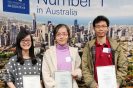
Học sinh của Công ty Đức Anh nhận học bổng 60.000 AUD tại Đại học Melbourne- ĐH số 1 tại Úc
Đại học Melbourne mới đây đã tổ chức lễ tuyên dương thành tích học tập của những sinh viên quốc tế nhận được Học bổng chương trình Cử nhân của…
Học sinh của Công ty Đức Anh nhận học bổng 60.000 AUD tại Đại học Melbourne- ĐH số 1 tại Úc
Trần Trọng Nhân- học sinh của công ty Đức Anh- đến từ trường phổ thông năng khiếu ĐHQG TP.HCM cùng 2 học sinh Việt Nam khác là Trần Phương Nga (Trường PTTH chuyên Lê Hồng Phong) và Đỗ Khánh Hiền (Trường PTTH chuyên Hà Nội-Amsterdam) đã nhận được các suất học bổng trị giá 60.000 AUD/người.
PTE A – kỳ thi tiếng Anh quốc tế mới xuất hiện tại Việt Nam
PTE Academic là gì? Kết quả được công nhận ở đâu? Thi thế nào? Chi phí? Thi ở đâu- khi nào và vì sao lại thi PTE Academic chứ không phải là các kỳ thi khác?… là những câu hỏi mà nhiều độc giả thắc mắc sau khi PTE Academic chính thức có mặt tại Việt Nam.