








EDUCATION SYSTEM IN GERMANY
Thứ Ba - 16/12/2025
Germany is home to one of the world’s highest-quality education systems and was ranked the 4th best country to live in according to the 2019 US News & World Report survey.
In Germany, students can choose to study:
- In German – offered at all public universities (tuition-free) and private schools (tuition-based);
- In English – offered at selected public universities and most private institutions (tuition-based).
1. Preschool Education
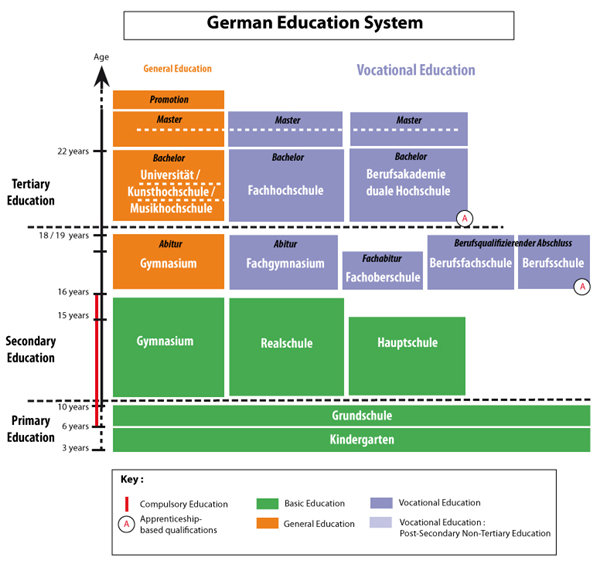
Preschools in Germany are operated mainly by churches or non-profit organizations and focus on childcare services. The system is divided into several groups:
- Kinderkrippe: for children aged 8 weeks to 3 years;
- Kita: for children aged 3 to 6, open from 7 AM to 5 PM;
- Kindergarten: for children aged 3 to 6 (half-day or full-day);
- Hort/Schulhort: after-school care for primary school students.
2. Primary Education
At age 6, children enter primary school (Grundschule), which lasts 4 years, except in Berlin and Brandenburg where it lasts 6 years. Most schools begin the academic year in September.
3. Secondary Education
Upon completing primary school (typically at age 10, or 12 in Berlin/Brandenburg), students move into one of five secondary school pathways:
- Hauptschule (Grades 5-9 or 5-10): The least common track in Germany, suitable for students aiming for vocational or industrial careers. Students receive basic vocational preparation and often work part-time as trainees. After a final exam in Grade 9 or 10, most transition to Berufsschule (vocational school) for 2 years;
- Realschule (Grades 5-10): Chosen by about 40% of German students annually. This track is similar to the U.S. middle-high school model and provides a balanced academic foundation;
- Mittelschule (Grades 5-10): A combined pathway featuring both vocational and academic elements (a hybrid of Hauptschule and Realschule);
- Gymnasium (Grades 5-12 or 5-13): For academically strong students aiming for university studies. The curriculum is theory-intensive, requiring two foreign languages and advanced coursework in mathematics and sciences;
- Gesamtschule (Grades 5-12 or 5-13): A comprehensive state school combining elements of the above three pathways.
4. Higher Education
a. Vocational Schools (Berufsschule) – 2 to 3 years: Although not formally part of the public education system, Berufsschule is heavily supported and regulated by the federal government. It combines classroom instruction with vocational training. Students usually enter after completing Realschule or Mittelschule.
b. Higher Education Institutions: As of 2013, Germany had 427 higher-education institutions, including 6 teacher-training colleges, 17 theological schools, 52 colleges of art, 215 universities of applied sciences (Fachhochschulen), 20 state-run training institutes. Less than 100 are private institutions.
Germany’s higher-education landscape includes:
- Universities (Universitäten): Focused on academic and theoretical instruction. All programs are research-based and follow the principle of “unity of research and teaching”. These institutions form the core of Germany’s traditional higher education system;
- Universities of Applied Sciences (Fachhochschulen): Practice-oriented programs that emphasize hands-on learning, professional skills, and industry relevance. Programs are structured and optimized for shorter study periods (typically 4 years). Graduates are highly employable, as many German and international companies prefer candidates with strong practical skills.
For tailored guidance and full assistance throughout your study-abroad journey, please contact:
Duc Anh EduConnect
Hotline: 09887 09698
Email: duhoc@ducanh.edu.vn
Website: www.ducanhduhoc.vn
Bài viết liên quan
Tự tin chinh phục Đại học Alberta, Top 4 Canada với combo ưu đãi cực chất
Bạn mơ ước du học Canada? Đại học Alberta đang chờ bạn với combo ưu đãi cực chất: Early Payment Scholarship: Giảm CAD 1.000 cho tất cả các sinh viên…
Du học New Zealand ngành Giáo dục Mầm non không yêu cầu phải có background về ngành?
Giáo dục mầm non (Early Childhood Education – ECE) đang là ngành thuộc nhóm thiếu hụt lao động và ưu tiên định cư tại New Zealand. Gần đây, INZ đã…
Du học Mỹ: The University of Tulsa – Học bổng lên đến 100% học phí & cơ hội đảm bảo việc làm sau tốt nghiệp
Đại học Tulsa (TU) tự hào là một trong 100 trường đại học nghiên cứu tư thục hàng đầu Hoa Kỳ, và đứng thứ 90 trong số tất cả các…
Úc- 2025: Dự kiến chỉ tiêu tuyển sinh sinh viên quốc tế vào 38 trường đại học công lập Úc
270,000 sinh viên sẽ được nhận vào học tại 38 trường Đại học công lập Úc? Giới hạn tuyển sinh sinh viên quốc tế là một phần trong nỗ lực…

Du học Mỹ: cùng Đại học Khoa học và Công nghệ Missouri (MST) khai phá tiềm năng của bản thân
Missouri S&T được thành lập vào năm 1870 với tiền thân là một trong những tổ chức công nghệ đầu tiên ở phía Tây Mississippi. Trường đã được xây dựng…

Học bổng 50% từ Đại học La Trobe cho năm học 2025
Đại học La Trobe công bố chương trình Học bổng 2025 mới nhất dành cho sinh viên quốc tế với 2 loại học bổng cực HOT: 1. La Trobe East…