









EDUCATION SYSTEM IN GERMANY
Thứ Ba - 16/12/2025
Germany is home to one of the world’s highest-quality education systems and was ranked the 4th best country to live in according to the 2019 US News & World Report survey.
In Germany, students can choose to study:
- In German – offered at all public universities (tuition-free) and private schools (tuition-based);
- In English – offered at selected public universities and most private institutions (tuition-based).
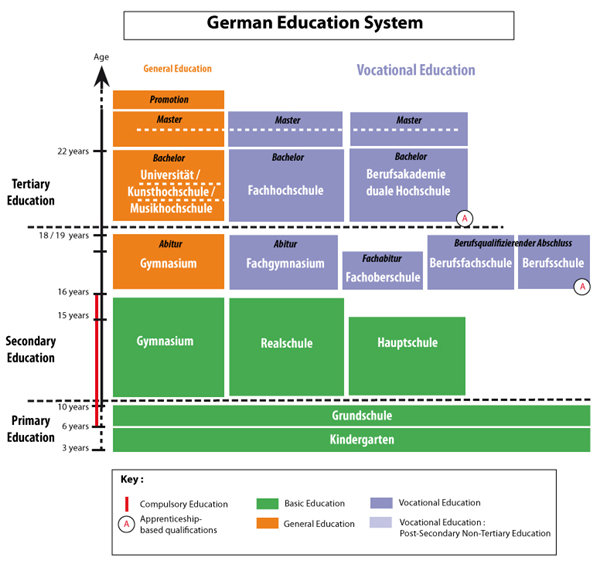
1. Preschool Education
Preschools in Germany are operated mainly by churches or non-profit organizations and focus on childcare services. The system is divided into several groups:
- Kinderkrippe: for children aged 8 weeks to 3 years;
- Kita: for children aged 3 to 6, open from 7 AM to 5 PM;
- Kindergarten: for children aged 3 to 6 (half-day or full-day);
- Hort/Schulhort: after-school care for primary school students.
2. Primary Education
At age 6, children enter primary school (Grundschule), which lasts 4 years, except in Berlin and Brandenburg where it lasts 6 years. Most schools begin the academic year in September.
3. Secondary Education
Upon completing primary school (typically at age 10, or 12 in Berlin/Brandenburg), students move into one of five secondary school pathways:
- Hauptschule (Grades 5-9 or 5-10): The least common track in Germany, suitable for students aiming for vocational or industrial careers. Students receive basic vocational preparation and often work part-time as trainees. After a final exam in Grade 9 or 10, most transition to Berufsschule (vocational school) for 2 years;
- Realschule (Grades 5-10): Chosen by about 40% of German students annually. This track is similar to the U.S. middle-high school model and provides a balanced academic foundation;
- Mittelschule (Grades 5-10): A combined pathway featuring both vocational and academic elements (a hybrid of Hauptschule and Realschule);
- Gymnasium (Grades 5-12 or 5-13): For academically strong students aiming for university studies. The curriculum is theory-intensive, requiring two foreign languages and advanced coursework in mathematics and sciences;
- Gesamtschule (Grades 5-12 or 5-13): A comprehensive state school combining elements of the above three pathways.
4. Higher Education
a. Vocational Schools (Berufsschule) – 2 to 3 years: Although not formally part of the public education system, Berufsschule is heavily supported and regulated by the federal government. It combines classroom instruction with vocational training. Students usually enter after completing Realschule or Mittelschule.
b. Higher Education Institutions: As of 2013, Germany had 427 higher-education institutions, including 6 teacher-training colleges, 17 theological schools, 52 colleges of art, 215 universities of applied sciences (Fachhochschulen), 20 state-run training institutes. Less than 100 are private institutions.
Germany’s higher-education landscape includes:
- Universities (Universitäten): Focused on academic and theoretical instruction. All programs are research-based and follow the principle of “unity of research and teaching”. These institutions form the core of Germany’s traditional higher education system;
- Universities of Applied Sciences (Fachhochschulen): Practice-oriented programs that emphasize hands-on learning, professional skills, and industry relevance. Programs are structured and optimized for shorter study periods (typically 4 years). Graduates are highly employable, as many German and international companies prefer candidates with strong practical skills.
For tailored guidance and full assistance throughout your study-abroad journey, please contact:
Duc Anh EduConnect
Hotline: 09887 09698
Email: duhoc@ducanh.edu.vn
Website: www.ducanhduhoc.vn
Bài viết liên quan

Học tập tại Scotland
‘Học tập ở Xcốt-len, bạn sẽ được tiếp nhận phương pháp học tập chất lượng cao đã được phát triển qua hàng thế kỷ và tư duy đổi mới đã được công nhận trên toàn thế giới. Mỗi năm, có hơn 30.000 sinh viên quốc tế từ hơn 180 quốc gia chọn Xcốt-len làm nơi học tập tại Vương quốc Anh – tại sao bạn không cùng gia nhập với họ?’
Học tập ở Bắc Ireland
‘Học tập ở Bắc Ireland, bạn sẽ được nhận cùng một chất lượng giáo dục tiêu chuẩn cao như bất cứ đâu tại Vương quốc Anh nhưng trong một cộng đồng nhỏ gọn, gắn kết. Bạn có thể dễ dàng đi lại ở Bắc Ireland, một nước chỉ có sáu địa hạt và 1,7 triệu người dân. Bạn sẽ tìm được mọi thứ bạn cần cho việc học tập ở đây: cuộc sống thanh bình, đời sống văn hóa xã hội ổn định và các cơ hội phát triển nghề nghiệp – tất cả mọi thứ đều trong tầm tay của bạn.’
Đăng ký xin học tại Anh
Bạn cần đọc kỹ phần thông tin hướng dẫn xin học tại Anh. Đồng thời, tham khảo chính sách visa du học Anh để xin học đúng nơi, đúng khóa học để được cấp visa du học. Bạn có thể tự đăng kí xin học, hoặc đang kí qua công ty tư vấn du học
Các trường phổ thông công lập Anh
The Các trường phổ thông tại anh được phân thành Ban giáo dục địa phương. Có 150 ban giáo dục nhu vậy, trong 9 khu vực rộng lớn của Anh và theo số liệu gần nhất, tổng cộng 3,117 trường phổ thông trung học tại Anh

Du học Anh: Visa DU HỌC- LÀM VIỆC- ĐỊNH CƯ
Thông tin chung, vui lòng xem thông tin visa sinh viên chung, visa học sinh nhỏ tuổi, và xét visa theo cách tính điểm. Để được cấp visa, bạn cần đạt 40 điểm
Học bổng du học Anh Quốc (Cập nhật tháng 12/2023)
Học bổng du học Anh Quốc