









EDUCATION SYSTEM IN GERMANY
Thứ Ba - 16/12/2025
Germany is home to one of the world’s highest-quality education systems and was ranked the 4th best country to live in according to the 2019 US News & World Report survey.
In Germany, students can choose to study:
- In German – offered at all public universities (tuition-free) and private schools (tuition-based);
- In English – offered at selected public universities and most private institutions (tuition-based).
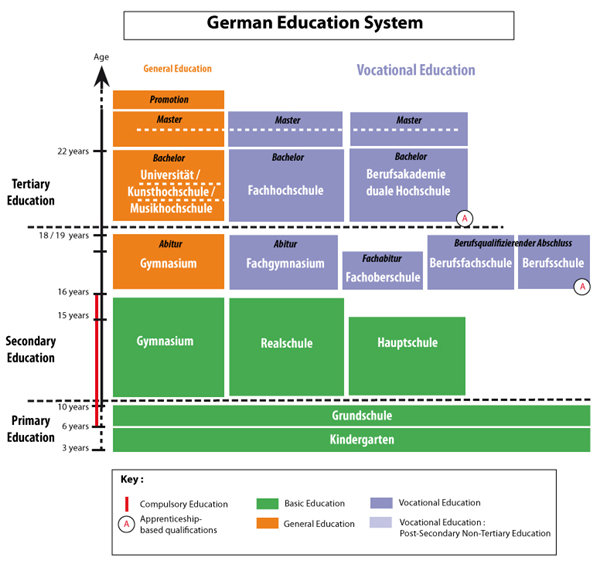
1. Preschool Education
Preschools in Germany are operated mainly by churches or non-profit organizations and focus on childcare services. The system is divided into several groups:
- Kinderkrippe: for children aged 8 weeks to 3 years;
- Kita: for children aged 3 to 6, open from 7 AM to 5 PM;
- Kindergarten: for children aged 3 to 6 (half-day or full-day);
- Hort/Schulhort: after-school care for primary school students.
2. Primary Education
At age 6, children enter primary school (Grundschule), which lasts 4 years, except in Berlin and Brandenburg where it lasts 6 years. Most schools begin the academic year in September.
3. Secondary Education
Upon completing primary school (typically at age 10, or 12 in Berlin/Brandenburg), students move into one of five secondary school pathways:
- Hauptschule (Grades 5-9 or 5-10): The least common track in Germany, suitable for students aiming for vocational or industrial careers. Students receive basic vocational preparation and often work part-time as trainees. After a final exam in Grade 9 or 10, most transition to Berufsschule (vocational school) for 2 years;
- Realschule (Grades 5-10): Chosen by about 40% of German students annually. This track is similar to the U.S. middle-high school model and provides a balanced academic foundation;
- Mittelschule (Grades 5-10): A combined pathway featuring both vocational and academic elements (a hybrid of Hauptschule and Realschule);
- Gymnasium (Grades 5-12 or 5-13): For academically strong students aiming for university studies. The curriculum is theory-intensive, requiring two foreign languages and advanced coursework in mathematics and sciences;
- Gesamtschule (Grades 5-12 or 5-13): A comprehensive state school combining elements of the above three pathways.
4. Higher Education
a. Vocational Schools (Berufsschule) – 2 to 3 years: Although not formally part of the public education system, Berufsschule is heavily supported and regulated by the federal government. It combines classroom instruction with vocational training. Students usually enter after completing Realschule or Mittelschule.
b. Higher Education Institutions: As of 2013, Germany had 427 higher-education institutions, including 6 teacher-training colleges, 17 theological schools, 52 colleges of art, 215 universities of applied sciences (Fachhochschulen), 20 state-run training institutes. Less than 100 are private institutions.
Germany’s higher-education landscape includes:
- Universities (Universitäten): Focused on academic and theoretical instruction. All programs are research-based and follow the principle of “unity of research and teaching”. These institutions form the core of Germany’s traditional higher education system;
- Universities of Applied Sciences (Fachhochschulen): Practice-oriented programs that emphasize hands-on learning, professional skills, and industry relevance. Programs are structured and optimized for shorter study periods (typically 4 years). Graduates are highly employable, as many German and international companies prefer candidates with strong practical skills.
For tailored guidance and full assistance throughout your study-abroad journey, please contact:
Duc Anh EduConnect
Hotline: 09887 09698
Email: duhoc@ducanh.edu.vn
Website: www.ducanhduhoc.vn
Bài viết liên quan

Kinh nghiệm phỏng vấn xin visa Canada
Không phải trường hợp nào LSQ Canada cũng yêu cầu phỏng vấn, tuy nhiên, các ững viên cần chủ động chuẩn bị để khi tham gia phỏng vấn thì sẽ thành công.
Các trường tiếng Anh – tiếng Pháp tại Canada
Như đã nói, tại Canada, có hai ngôn ngữ chính thức được sử dụng, có nghĩa là học sinh quốc tế có thể đến Canada để học tập bằng tiếng Anh (ESL) hoặc bằng tiếng Pháp như là sinh ngữ hai (FSL) . Nhiều người chọn học bằng tiếng Anh ở Canada do có nhiều trường dạy tiếng Anh xuất sắc và do giọng Canada trung hòa dễ nghe.
Các trường cao đẳng Canada
Chương trình đào tạo tại các trường cao đẳng thường mang tính thực tiễn cao và thực hành nhiều, mang tính đào tạo nghề cao hơn so với đại học, vì vậy, nhiều sinh viên đãc tốt nghiệp đại học vẫn quay lại học cao đẳng để có thêm kỹ năng. Các lớp học tại các college thường có sĩ số nhỏ, có các khóa học thực tập bên ngoài trường, không gian lớp học và phòng lab thông thoáng, cách giảng dạy tác động qua lại và luôn có nhiều cấp độ nhập học khác nhau từ các ngành kỹ thuật cho đến các ngành nghệ thuật sáng tạo…
Chi phí du học Canada
So với du học các nước khác, du học Canada khá rẻ, do chi phí sinh hoạt Canada khá ổn định- trong khi vẫn đảm bảo mức sống cao nhất nhì thế giới
Các trường đại học tại Anh – thông tin chung
Các trường đại học Anh đào tạo chủ yếu hai bậc học: cử nhân và sau đại học (thạc sỹ, tiến sỹ)…
Các trường đại học quốc tế tại Anh
Có 20 trường, trong đó có các trường đại học quốc tế đào tạo sinh viên toàn thời tại Anh, các trường đại học quốc tế đào tạo các kì học tại Anh….