









EDUCATION SYSTEM IN JAPAN
Thứ Ba - 16/12/2025
The current Japanese education system was established shortly after World War II, between 1947 and 1950, modeled closely on the American system. Guided by the philosophy “No child in any family, and no family in any community, should be deprived of education,” Japan aims to ensure the all-rounded development of children – emotionally, intellectually, morally, socially, and spiritually. This holistic approach has become the core educational philosophy of Japan, known as kokoro.
Japan’s education system consists of 6 years of primary school, 3 years of lower secondary school, 3 years of upper secondary school, and 4 years of university. Primary and lower secondary education are compulsory, meaning all children aged 6 to 15 must attend school.
Types of schools in Japan
- Kindergarten (1 to 3 years)
- Primary School (6 years, ages 6-12)
- Lower Secondary School (3 years, ages 13-15)
- Upper Secondary School (3 years)
- Junior College (2 years, some departments 3 years)
- Colleges of Technology (5 to 5.5 years)
- Short-term University (2 years)
- Regular University (4 years)
- Vocational Schools (1 year or more)
- Specialized Training Colleges (1 year or more)
Japan is actively implementing policies to attract international students. Many Japanese language preparatory schools have been established to meet growing demand – such as Kurume, Koiwa, Osaka Language Academy, and more. The Japanese government also provides various forms of support to international students, including full scholarships, tuition waivers, housing assistance, and living subsidies.
Academic Calendar:
The Japanese academic year typically begins in April and ends in March of the following year. Most institutions follow a two-semester system: Semester 1: April – September and Semester 2: October – March. Some schools use a three-semester or quarter (four-semester) system instead.
I. Compulsory Education
1. Primary and Lower Secondary Education
Primary and lower secondary education are compulsory for Japanese children. When a child reaches school age, families receive official notices from local authorities and must complete required procedures such as health checks before enrollment.
For foreign residents, because compulsory education does not apply in the same way, admission notices are not issued automatically. However, families who wish their children to attend public schools must submit an application for school admission. Once accepted, parents must complete registration procedures, including providing the child’s foreign resident certificate and the official admission notice to the municipal office.
Public primary and lower secondary schools do not charge tuition fees, though school lunch fees may apply. Students who graduate from public primary and lower secondary schools may advance to university without entrance exams in certain cases. Individuals over 16 who do not hold Japanese citizenship, as well as adult learners attending evening schools, may also qualify for university admission. Even those who did not complete primary or lower secondary education in their home country may still pursue university studies in Japan—without concerns about tuition fees or academic level restrictions.
2. Upper Secondary School (High School)
After completing lower secondary school, students may advance to: Upper secondary school (High school), or Technical/vocational high schools. Since upper secondary education is not compulsory, students must apply and sit entrance examinations if required. General upper secondary programs last 3 years (longer for part-time or distance-learning programs).
High schools in Japan teach practical, career-oriented skills, including: Agricultural High Schools, Industrial High Schools, Commercial High Schools and various specialized vocational high schools. Specialized high schools (5-year programs) provide deeper training and prepare students for employment or progression to university. Popular specializations include industrial technology, maritime studies, electrical engineering, and navigation. Students graduating from part-time or distance-learning high schools are also eligible to apply for colleges or universities.
II. Higher Education
Post-secondary education in Japan includes five types of institutions:
- Colleges of Technology
- Vocational Schools (Specialized Training Colleges)
- Junior Colleges
- Universities
- Graduate Schools
Depending on the founding authority, institutions may be classified as:
- National: managed by the national government
- Prefectural: established and managed by local governments
- Private: established and operated by private organizations
Since the 1970s, Japan has introduced strict policies to regulate private institutions and ensure the quality of university graduates.
There are currently around 60 junior colleges and 700 universities. Junior college programs last 1-3 years, while most university programs last 4 years, except for Medicine, Dentistry, and Veterinary Science, which require 6 years of study.
For tailored guidance and full assistance throughout your study-abroad journey, please contact us HERE:
Duc Anh EduConnect
Hotline: 09887 09698, 09630 49860
Email: duhoc@ducanh.edu.vn
Website: ducanhduhoc.vn/
Bài viết liên quan

Giới thiệu về 2 đại diện Đại học Queensland
Professor Sarah Roberts-Thomson Head (Dean) of the School of Pharmacy Faculty of Health and Behavioural Sciences, University of Queensland Sarah is a first class Pharmacy Honours and PhD graduate from…
Sở Giáo dục và Đào tạo TP HCM trao GIẤY KHEN cho công ty tư vấn du học Đức Anh
Đức Anh A&T là một trong số rất ít công ty tư vấn du học được trao giấy khen trong “Hội nghị Tổng kết năm học 2022-2023 & triển khai…

Tham dự NGÀY HỘI GIÁO DỤC NEW ZEALAND 2023 – Nhận ngay 500 NZD hỗ trợ từ Đức Anh EduConnect
I. Hỗ trợ 500 NZD/học sinh: Đây là hỗ trợ đặc biệt, DUY NHẤT 1 lần trong 2 năm trở lại đây, “Settling Down Support”, dành riêng cho học sinh-…

Du học UK – Vì sao vẫn nhiều người chọn?
UK đắt đỏ ~~ UK lạnh lùng ~~ UK ở Châu Âu với ảnh hưởng của chiến tranh… UK- ĐIỂM DU HỌC TRUYỀN THỐNG Bất luận các nhận định trên,…
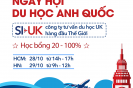
Mời dự Ngày hội du học Anh Quốc: Học bổng 20-100%
Sự kiện được tổ chức tại: TP HCM: ngày 28- 10- 2023, 14h- 17h tại Liberty Central Saigon City Point, 59 Pasteur, Bến Nghé, Q.1 Hà Nội: ngày 29- 10-…
Hội thảo du học Úc: Business Analytics- Computer Science- Ngành học dễ tìm việc làm & định cư nhất!
Business Analytics & Computer Science là những ngành học không khó nhưng đang rất thời thượng, thu nhập cao, không sợ thiếu việc làm và sẽ còn nằm trong danh…