









FINLAND’S EDUCATION SYSTEM
Thứ Năm - 18/12/2025
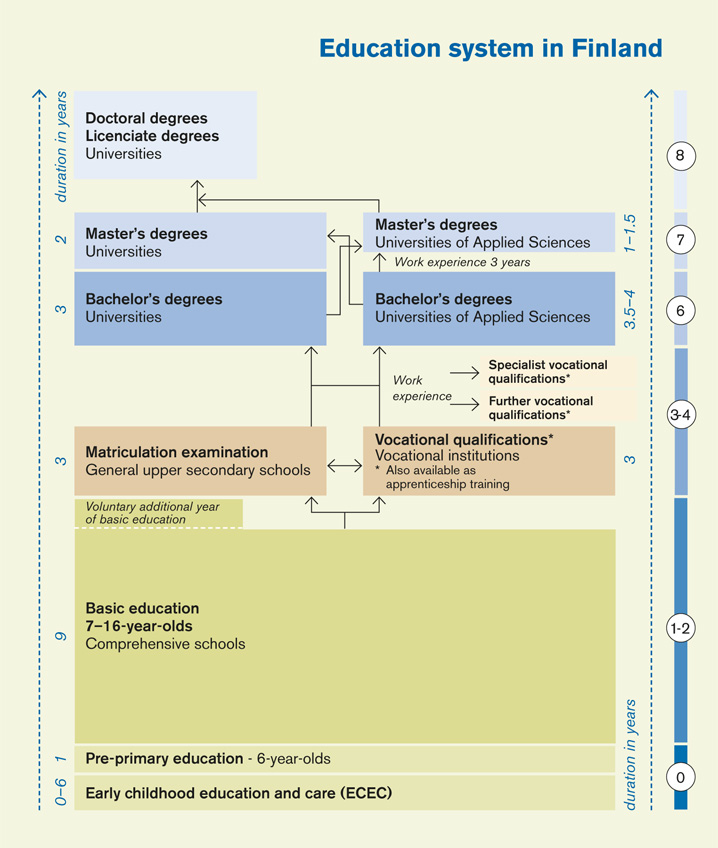
The education system in Finland is completely free of charge for Finnish citizens and is divided into the following levels:
- Early childhood education and care (non-compulsory): for children aged 0-5;
- Pre-primary education (non-compulsory): 1 year, for children aged 6;
- Compulsory basic education: lasts 9 years, for students aged 7-16. This is the only compulsory level of schooling for Finnish students (equivalent to primary and lower secondary education). Students attend comprehensive schools: during the first 6 years, each class is taught by one main teacher (except for arts and skills subjects), and during the final 3 years, students are taught by subject-specific teachers (e.g., Mathematics, Science, etc.).
Education after completing grade 9 (age 16) is voluntary. Finland does not place heavy emphasis on pushing students toward university but instead balances pathways between academic higher education and vocational training.
- Upper secondary education: lasts 3 years (ages 17-19), and students can choose between two options:
- General upper secondary schools: prepare students for the national matriculation examination (the Finnish Matriculation Exam), suitable for academically strong students who wish to continue to higher education;
- Vocational qualifications: offered at vocational institutions, providing training in various occupational fields.
- Higher Education (Universities and Universities of Applied Sciences): consists of two parallel sectors – universities and Universities of Applied Sciences (UAS).
- Universities: focus on academic research and advanced education related to research, offering Bachelor’s, Master’s, postgraduate diplomas, and Doctoral degrees;
- Universities of Applied Sciences (UAS): focus on professional and practical training with strong links to working life, suitable for students who wish to enter the workforce soon after graduation. These institutions award professional Bachelor’s and Master’s degrees, after which students may continue to doctoral studies.
For tailored guidance and full assistance throughout your study-abroad journey, please contact:
Duc Anh EduConnect
Hotline: 09887 09698
Email: duhoc@ducanh.edu.vn
Website: www.ducanhduhoc.vn
Bài viết liên quan
9X đầu tiên nhận học bổng 1 tỷ đồng ở trường nghệ thuật Anh
Nguyễn Kim Chi là gương mặt trẻ đầu tiên giành được học bổng 50% của một trong những ngôi trường nghệ thuật hàng đầu nước Anh. Là một trong những…

Mẹo thi PTE điểm cao
Các bạn hãy “bỏ túi” những mẹo thi PTE điểm cao này nhé! Đây sẽ là những hành trang bí mật để bạn có thể đạt được mục tiêu phấn đấu của mình trong kỳ thi PTE đấy!
Ngày hội du học 5 châu tại Hồ Chí Minh và Vũng Tàu
Ngày hội du học Anh, Úc, Mỹ, New Zealand, Canada, Hà Lan, Thụy Sỹ, Singapore, Nhật Bản là cơ hội lý tưởng để du học sinh tìm hiểu cơ hội…
New Zealand không có kế hoạch thay đổi chính sách nhập cư
Sau khi tốt nghiệp sinh viên được phép ở lại làm việc 1-2 năm. Chính phủ New Zealand cũng đang khuyến khích, tạo điều kiện để sinh viên, những người thực sự yêu mến đất nước xinh đẹp này ở lại sinh sống tại New Zealand, góp phần thúc đẩy tăng trưởng kinh tế. Chính vì vậy, cơ hội định cư tại New Zealand đối với du học sinh là rất cao.
Du học New Zealand : New Zealand không có kế hoạch thay đổi chính sách nhập cư
Sau khi tốt nghiệp sinh viên được phép ở lại làm việc 1-2 năm. Chính phủ New Zealand cũng đang khuyến khích, tạo điều kiện để sinh viên, những người thực sự yêu mến đất nước xinh đẹp này ở lại sinh sống tại New Zealand, góp phần thúc đẩy tăng trưởng kinh tế. Chính vì vậy, cơ hội định cư tại New Zealand đối với du học sinh là rất cao.
Tuần lễ “Du học Đại học Sounthern Cross”, Úc
Với Đại học Southern Cross (SCU), bạn có thể chọn học tại Sydney, Melbourne hoặc Gold Coast, với học phí rẻ nhất nhì nước Úc và cơ hội làm việc rộng mở trên toàn nước Úc.