









FINLAND’S EDUCATION SYSTEM
Thứ Năm - 18/12/2025
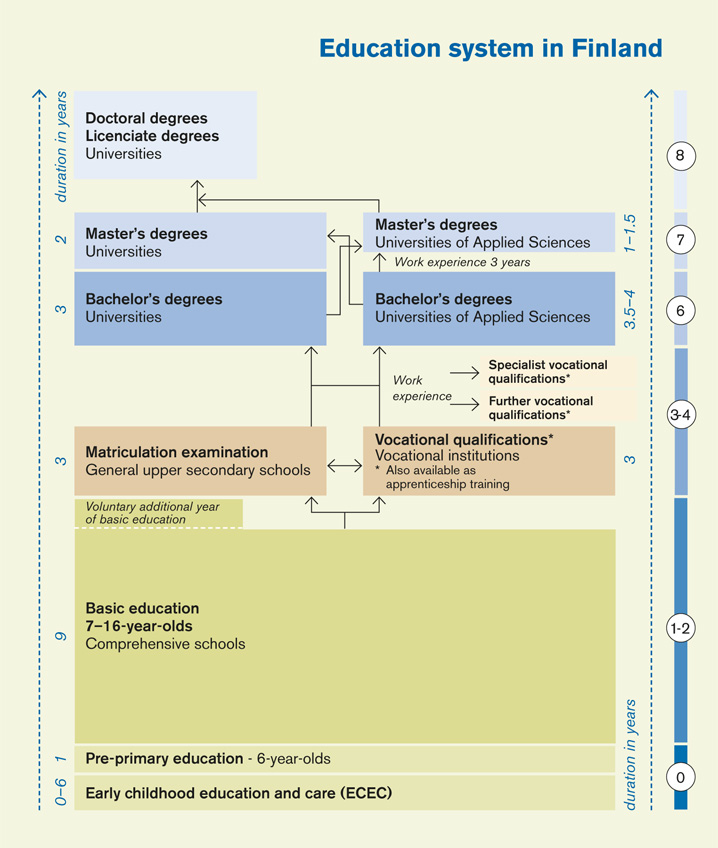
The education system in Finland is completely free of charge for Finnish citizens and is divided into the following levels:
- Early childhood education and care (non-compulsory): for children aged 0-5;
- Pre-primary education (non-compulsory): 1 year, for children aged 6;
- Compulsory basic education: lasts 9 years, for students aged 7-16. This is the only compulsory level of schooling for Finnish students (equivalent to primary and lower secondary education). Students attend comprehensive schools: during the first 6 years, each class is taught by one main teacher (except for arts and skills subjects), and during the final 3 years, students are taught by subject-specific teachers (e.g., Mathematics, Science, etc.).
Education after completing grade 9 (age 16) is voluntary. Finland does not place heavy emphasis on pushing students toward university but instead balances pathways between academic higher education and vocational training.
- Upper secondary education: lasts 3 years (ages 17-19), and students can choose between two options:
- General upper secondary schools: prepare students for the national matriculation examination (the Finnish Matriculation Exam), suitable for academically strong students who wish to continue to higher education;
- Vocational qualifications: offered at vocational institutions, providing training in various occupational fields.
- Higher Education (Universities and Universities of Applied Sciences): consists of two parallel sectors – universities and Universities of Applied Sciences (UAS).
- Universities: focus on academic research and advanced education related to research, offering Bachelor’s, Master’s, postgraduate diplomas, and Doctoral degrees;
- Universities of Applied Sciences (UAS): focus on professional and practical training with strong links to working life, suitable for students who wish to enter the workforce soon after graduation. These institutions award professional Bachelor’s and Master’s degrees, after which students may continue to doctoral studies.
For tailored guidance and full assistance throughout your study-abroad journey, please contact:
Duc Anh EduConnect
Hotline: 09887 09698
Email: duhoc@ducanh.edu.vn
Website: www.ducanhduhoc.vn
Bài viết liên quan

Ngày hội thông tin du học Anh – Mỹ: học bổng đến 100% học phí.
Trân trọng mời các phụ Huynh và học sinh tham dự ngày hội thông tin du học Anh, Mỹ, được tổ chức tại:
TP. Hồ Chí Minh: ngày 22/ 3/ 2014, từ 8h30- 12h, tại KS Sheraton, số 88 Đồng Khởi, Quận 1;
TP Hà Nội: ngày 23/ 3/ 2014, từ 9h-12h, tại Tầng 3, Đức Anh Building, 54-56 Tuệ Tĩnh, Q. Hai Bà Trưng.
Hội thảo: Trinity College- đại học Melbourne: TOP về đào tạo dự bị đại học Úc
Được đánh giá là một trong những trường đạo tạo chương trình Dự bị chất lượng nhất tại Úc, Trinity College là lựa chọn đầu tiên của không chỉ các học sinh, sinh viên có nguyện vọng học tại Đại học Melbourne mà còn tại các trường Đại học tốt nhất trên Thế giới. 5 học sinh đầu tiên đăng ký nhập học chương trình Dự bị Đại học khai giảng tháng 7 hoặc tháng 10/2014 sẽ được tặng vé máy bay đến Melbourne, trị giá 500USD.
Học bổng đến 100% học phí từ Đại học La Trobe, Úc
La Trobe hiện có học bổng chương trình nghiên cứu sau đại học: học bổng LTUPRS trị giá AUD 25,000 và học bổng 100% học phí LTUFFRS trị giá AUD 22,960- 27,800, cùng các chương trình học bổng khác tại trường dành cho các học sinh khá giỏi.
Mời gặp các trường đào tạo Quản trị Khách sạn – chương trình thực hành có trả lương
Du học ngành Khách sạn Du lịch là chương trình rất hữu ích và hiệu quả với sinh viên, vừa đảm bảo việc học tập vừa kiếm thêm tiền chi trả cho cuộc sống thay vì học miệt mài trên giảng đường và phải tự ra ngoài tìm việc làm thêm. Các bạn sẽ được học 6 tháng lý thuyết, 6 tháng thực hành hưởng lương: tại Thụy Sỹ là 2,200-2,500 CHF/tháng (tương đương 60 triệu VND/tháng) và tại Úc là khoảng 3,200 AUD/tháng (tương đương 61,4 triệu VND/tháng).
Học tại Singapore nhận bằng Anh quốc với học bổng đến 10.000 SGD
Học viện ERC được sáng lập bởi những nhà quản trị doanh nghiệp danh tiếng khu vực châu Á với mục tiêu đào tạo nên đội ngũ các nhà lãnh đạo trẻ xuất sắc. ERC tự hào là một trong chín trường tư đầu tiên của Singapore vinh dự đạt EDUTRUST (4 năm)- Danh hiệu cao quý về chất lượng giáo dục.
Mời gặp các trường TOP của Úc tại Triển lãm Du học EduConnect
Triển lãm du học Đức Anh EduConnect là cơ hội lớn nhất trong năm để các du học sinh tương lai trao đổi trực tiếp với các trường hàng đầu tại Úc, tìm kiếm các cơ hội học tập, học bổng, việc làm và định cư.