









FINLAND’S EDUCATION SYSTEM
Thứ Năm - 18/12/2025
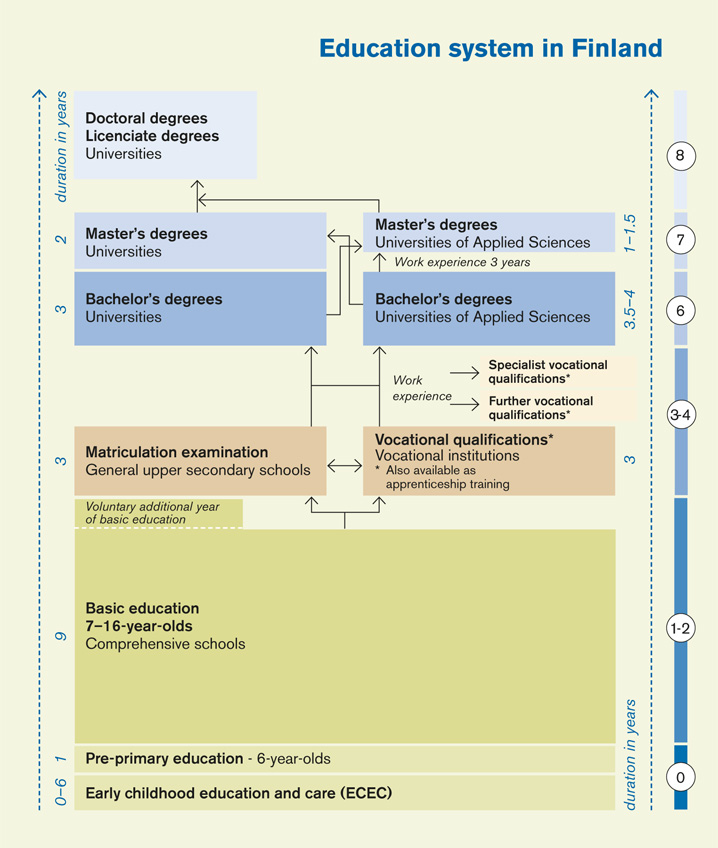
The education system in Finland is completely free of charge for Finnish citizens and is divided into the following levels:
- Early childhood education and care (non-compulsory): for children aged 0-5;
- Pre-primary education (non-compulsory): 1 year, for children aged 6;
- Compulsory basic education: lasts 9 years, for students aged 7-16. This is the only compulsory level of schooling for Finnish students (equivalent to primary and lower secondary education). Students attend comprehensive schools: during the first 6 years, each class is taught by one main teacher (except for arts and skills subjects), and during the final 3 years, students are taught by subject-specific teachers (e.g., Mathematics, Science, etc.).
Education after completing grade 9 (age 16) is voluntary. Finland does not place heavy emphasis on pushing students toward university but instead balances pathways between academic higher education and vocational training.
- Upper secondary education: lasts 3 years (ages 17-19), and students can choose between two options:
- General upper secondary schools: prepare students for the national matriculation examination (the Finnish Matriculation Exam), suitable for academically strong students who wish to continue to higher education;
- Vocational qualifications: offered at vocational institutions, providing training in various occupational fields.
- Higher Education (Universities and Universities of Applied Sciences): consists of two parallel sectors – universities and Universities of Applied Sciences (UAS).
- Universities: focus on academic research and advanced education related to research, offering Bachelor’s, Master’s, postgraduate diplomas, and Doctoral degrees;
- Universities of Applied Sciences (UAS): focus on professional and practical training with strong links to working life, suitable for students who wish to enter the workforce soon after graduation. These institutions award professional Bachelor’s and Master’s degrees, after which students may continue to doctoral studies.
For tailored guidance and full assistance throughout your study-abroad journey, please contact:
Duc Anh EduConnect
Hotline: 09887 09698
Email: duhoc@ducanh.edu.vn
Website: www.ducanhduhoc.vn
Bài viết liên quan

Học bổng Đại học tại trường Đại học Newcastle bản Tiếng Anh
NCL Scholarship Announcement 2013-14 Tag xem thêm: du hoc uc, du hoc my, du hoc anh
Kỳ 4: Nhu cầu việc làm trong lĩnh vực chăm sóc cộng đồng đang có xu hướng tăng cao
Vai trò của dịch vụ chăm sóc cộng đồng ngày càng trở nên quan trọng trong việc làm gia tăng chất lượng cuộc sống, điều mà quốc gia nào cũng hướng tới khi phát triển chính sách
Kỳ 3: Nghề chăm sóc người già và trẻ em tại Úc – Cơ hội định cư
Việc làm cho những người chăm sóc trẻ em dự kiến sẽ phát triển rất mạnh mẽ trong năm 2016-2017. Số lượng lao động trong nghề này rất lớn 115.100 người (số liệu tháng 11/2011, tăng 18,8% so với năm 2006)
Kỳ 2: Dịch vụ công tác xã hội- Kinh nghiệm từ các nước trên thế giới
Tại nhiều nước, các dịch vụ xã hội (DVXH) đã trở nên chuyên nghiệp hóa nhờ có sự tham gia đông đảo của đội ngũ cán bộ xã hội được đào tạo ở các trình độ cử nhân, thạc sĩ và tiến sĩ
Chọn Đại học Canberra – Chọn sự phát triển toàn diện cho bạn
Tọa lạc tại vị trí đắc địa của thủ đô Canberra, nơi tập trung các cơ quan hành chính, ngoại giao của Úc cũng như trụ sở của nhiều công ty, tập đoàn lớn trên thế giới, Đại học Canberra (UC) giữ vị trí quan trọng tại điểm giao thoa giữa doanh nghiệp và cơ quan chính phủ
Chọn lộ trình học phổ thông tại Anh thế nào?
Nếu em muốn nhập học tháng 9/ 2013, em cần nộp hồ sơ sớm để có chỗ học. Các trường thường không nhận hồ sơ xin học sau trung tuần tháng 6 nhưng trên thực tế, hồ sơ đến trước được xét trước và em sẽ không còn chỗ học nếu trường em đăng kí đã bị đầy.