









FINLAND’S EDUCATION SYSTEM
Thứ Năm - 18/12/2025
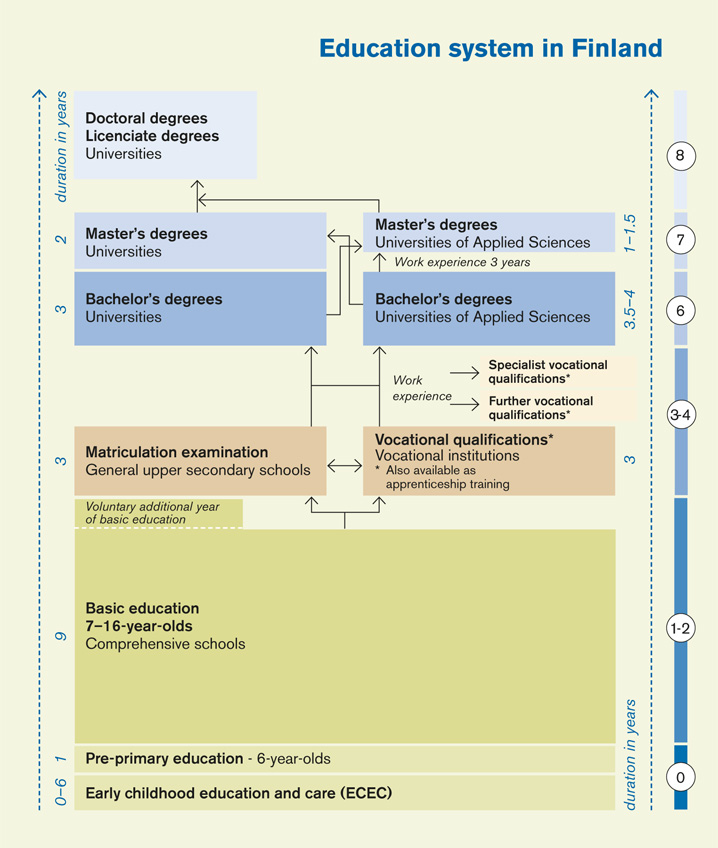
The education system in Finland is completely free of charge for Finnish citizens and is divided into the following levels:
- Early childhood education and care (non-compulsory): for children aged 0-5;
- Pre-primary education (non-compulsory): 1 year, for children aged 6;
- Compulsory basic education: lasts 9 years, for students aged 7-16. This is the only compulsory level of schooling for Finnish students (equivalent to primary and lower secondary education). Students attend comprehensive schools: during the first 6 years, each class is taught by one main teacher (except for arts and skills subjects), and during the final 3 years, students are taught by subject-specific teachers (e.g., Mathematics, Science, etc.).
Education after completing grade 9 (age 16) is voluntary. Finland does not place heavy emphasis on pushing students toward university but instead balances pathways between academic higher education and vocational training.
- Upper secondary education: lasts 3 years (ages 17-19), and students can choose between two options:
- General upper secondary schools: prepare students for the national matriculation examination (the Finnish Matriculation Exam), suitable for academically strong students who wish to continue to higher education;
- Vocational qualifications: offered at vocational institutions, providing training in various occupational fields.
- Higher Education (Universities and Universities of Applied Sciences): consists of two parallel sectors – universities and Universities of Applied Sciences (UAS).
- Universities: focus on academic research and advanced education related to research, offering Bachelor’s, Master’s, postgraduate diplomas, and Doctoral degrees;
- Universities of Applied Sciences (UAS): focus on professional and practical training with strong links to working life, suitable for students who wish to enter the workforce soon after graduation. These institutions award professional Bachelor’s and Master’s degrees, after which students may continue to doctoral studies.
For tailored guidance and full assistance throughout your study-abroad journey, please contact:
Duc Anh EduConnect
Hotline: 09887 09698
Email: duhoc@ducanh.edu.vn
Website: www.ducanhduhoc.vn
Bài viết liên quan

Kỳ 6: Luật sư và các vụ tai tiếng
Luật sư là người bảo vệ công lý, lẽ phải, quyền và lợi ích hợp pháp của cá nhân, tổ chức và quyền tự do, dân chủ, pháp chế XHCN. Nếu họ vi phạm đạo đức thì không những không bảo vệ được mà còn tác dụng rất xấu tới dư luận xã hội và uy tín nghề nghiệp.
Kỳ 5: Luật sư chuyên ly hôn – “Hái ra tiền” thời hiện đại
Việc ly hôn ít ai mong muốn. Khi vấn đề ly hôn được đặt ra thì việc giải quyết sao cho êm đẹp để các bên đỡ bị tổn thương, con cái đỡ bị thiệt thòi là việc mà không phải ai cũng làm được.
Danh sách tham khảo các trường cao đẳng tại Malaysia.
Danh sách tham khảo các trường cao đẳng tại Malaysia.

Danh sách các trường Đại học tại Hà Lan
Hà Lan có hai loại trường: đại học nghiên cứu và đại học khoa học ứng dụng. Thông tin thêm về các trường đại học tại Hà Lan, tham khảo tại đây
Các trường đại học Thụy Sỹ
Thụy Sĩ nổi tiếng về hệ thống giáo dục kinh doanh cao cấp. Trong các trường đại học và các trường đào tạo chương trình thạc sỹ quản trị kinh doanh hàng đầu trên thế giới như Viện quốc tế Phát triển quản lý St. Gallen là trường thuộc loại này.
Danh sách các trường đại học tại Thụy Sỹ
Theo quy định của pháp luật Thụy Sĩ về các trường đại học công ở Thụy Sĩ và cơ quan CRUS, có 12 trường đại học tại Thụy Sĩ (10 trường trực thuộc bang và 2 viện công nghệ trực thuộc liên bang và một số trường đại học chuyên ngành)