









FINLAND’S EDUCATION SYSTEM
Thứ Năm - 18/12/2025
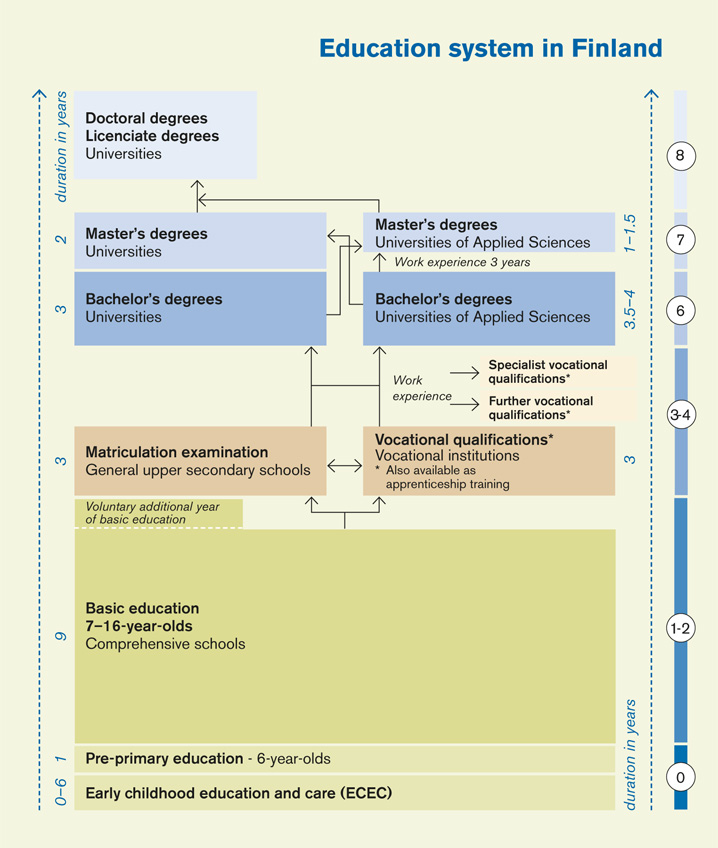
The education system in Finland is completely free of charge for Finnish citizens and is divided into the following levels:
- Early childhood education and care (non-compulsory): for children aged 0-5;
- Pre-primary education (non-compulsory): 1 year, for children aged 6;
- Compulsory basic education: lasts 9 years, for students aged 7-16. This is the only compulsory level of schooling for Finnish students (equivalent to primary and lower secondary education). Students attend comprehensive schools: during the first 6 years, each class is taught by one main teacher (except for arts and skills subjects), and during the final 3 years, students are taught by subject-specific teachers (e.g., Mathematics, Science, etc.).
Education after completing grade 9 (age 16) is voluntary. Finland does not place heavy emphasis on pushing students toward university but instead balances pathways between academic higher education and vocational training.
- Upper secondary education: lasts 3 years (ages 17-19), and students can choose between two options:
- General upper secondary schools: prepare students for the national matriculation examination (the Finnish Matriculation Exam), suitable for academically strong students who wish to continue to higher education;
- Vocational qualifications: offered at vocational institutions, providing training in various occupational fields.
- Higher Education (Universities and Universities of Applied Sciences): consists of two parallel sectors – universities and Universities of Applied Sciences (UAS).
- Universities: focus on academic research and advanced education related to research, offering Bachelor’s, Master’s, postgraduate diplomas, and Doctoral degrees;
- Universities of Applied Sciences (UAS): focus on professional and practical training with strong links to working life, suitable for students who wish to enter the workforce soon after graduation. These institutions award professional Bachelor’s and Master’s degrees, after which students may continue to doctoral studies.
For tailored guidance and full assistance throughout your study-abroad journey, please contact:
Duc Anh EduConnect
Hotline: 09887 09698
Email: duhoc@ducanh.edu.vn
Website: www.ducanhduhoc.vn
Bài viết liên quan

Vì sao chọn du học Úc
Học tập tại Úc, bạn được nhận những hỗ trợ to lớn từ nhà nước Úc. Các điều luật, quy định đưới đây thể hiện nỗ lực đảm bảo quyền lợi học tập và phát duy năng lực của các du học sinh: Công nhận bằng cấp của các quốc gia khác, tạo điều kiện cho học sinh nước khác đến du học tại Úc
Tiệc Giáng sinh 2013 tại Trung tâm Anh ngữ Dace
[slideshow post_id=”7740″] Tag xem thêm: du hoc uc, du hoc my, du hoc anh
Các trường cao đẳng tại Anh
Thời gian học các khóa đào tạo nghề có thể từ 6 tháng đến 2 năm và đặc điểm chung của các khóa học này là: yêu cầu đầu vào linh hoạtm đa dạng về ngành nghề, tnh thưc tiễn cao, kiến thức học được xem xét tính để miễn trừ một phần trong chương trình học cao hơn, bậc cao đẳng hoặc cử nhân.
Phỏng vấn visa du học Mỹ: Làm sao để thành công
Nhiều bạn có ý định du học Mỹ nhưng lại “chùn chân” khi gặp khó khăn trong khâu phỏng vấn visa. Dưới đây là tổng hợp các thông tin, kinh nghiệm của những người đi trước và những điều sinh viên cần lưu ý khi đi phỏng vấn xin visa du học.
Học bổng du học Úc
Để tìm hiểu thêm thông tin về các chương trình học bổng tại Australia, mời bạn sử dụng Trang Thông Tin Học Bổng. Tại đây, bạn sẽ tìm thấy danh sách đáng tin cậy và chính xác về tất cả học bổng do các tổ chức có trụ sở tại Australia
Du học Úc: học bổng tại 30 trường đại học, cao đẳng
Với du học Úc, học phí chương trình phổ thông từ 10,00-12,000aud/ năm học, cao đẳng từ 9000- 12,000aud/ năm, đại học từ 16,000- 33,000aud/ năm học. Phí sinh hoạt thực tế tại Úc khỏang 8,000- 14,000aud/ năm, tùy cách chi tiêu của từng học sinh.