









UNIVERSITIES IN GERMANY
Thứ Ba - 16/12/2025
See List of Universities in Germany
As noted, in Germany you may choose to study:
- In German – at all public universities (free of tuition) and private institutions (tuition-based); or:
- In English – at certain public universities and most private institutions (tuition-based).
To study at a university, students must have an Abitur or Fachabitur, which is considered equivalent to completing upper secondary school or the first year of university.
Germany’s higher education system is divided into two main types of institutions, either public or private, offering programs in German or in English:
- Universität, Technische Universität (comprehensive universities);
- Fachhochschule – FH (universities of applied sciences).
In addition, there are music academies or fine arts academies (Musik- oder Kunstakademie). With an Abitur, students may apply to both Uni and FH programs. With a Fachabitur, students may only apply to FH programs, not Uni. So how are Uni and FH different? And do their degrees affect employment later on?
German universities and FHs phased out the old “Diplom” degrees (equivalent to Bachelor of Engineering, Bachelor of Science, etc.) nearly a decade ago, and transitioned to international-degree formats: Bachelor (3 years) and Master (2 years).
Studying at a Uni is more theory-oriented and research-focused. During the program, students are not required to attend lectures, making the study process more flexible and independent. In contrast, studying at an FH focuses heavily on practical application. Programs are more structured and organized than at Uni, and most students must attend lectures. FH groups are usually much smaller (dozens of students) compared to Uni (hundreds), allowing students to gain stronger hands-on experience. Additionally, FH students must complete at least one compulsory internship (Praktikum), meaning the Bachelor’s degree often takes longer than at Uni. At most Uni programs, internships are not mandatory; if students choose to complete one, the duration of the Bachelor’s program becomes 3 years plus internship time. Otherwise, students complete their Bachelor’s degree in 3 years.
FH degrees and Uni degrees at both Bachelor’s and Master’s levels are considered equal. Students should choose Uni or FH based on their intended field of study. Engineering and technical fields are more suited to FHs because students receive more applied and practical training. Fields such as economics – especially investment banking – or research-oriented programs are usually better pursued at Uni. Students may also complete a Bachelor’s degree at an FH and move on to a Master’s degree at a Uni, or vice versa.
Besides these two main university systems, many universities in Germany cooperate with companies to offer dual-study programs (Duales Studium). In this format, students alternate between academic study and work placement. During both study and work periods, students receive a salary from the company, depending on the contract between the two parties. Admission into this pathway is competitive: first, students must find out whether their chosen university offers this model; if so, in which majors and with which partner companies. Students must then apply directly to the company for selection. The benefits are significant-students study and work at the same time, earn income, and have strong chances of being hired by the company after graduation. However, this format is also demanding, with very limited vacation time (Semesterferien).
Germany’s degree structure:
As in most European countries, the German qualification system consists of three levels:
- Bachelor: 3-4 years;
- Master: 1-2 years;
- Doctor: 3-5 years.
Bachelor’s and Master’s programs require final examinations for graduation. For certain fields such as medicine, dentistry, law, pharmacy, and teacher training, students must pass additional state-regulated examinations before graduating.
For tailored guidance and full assistance throughout your study-abroad journey, please contact:
Duc Anh EduConnect
Hotline: 09887 09698
Email: duhoc@ducanh.edu.vn
Website: www.ducanhduhoc.vn
Bài viết liên quan

HỆ THỐNG GIÁO DỤC NHẬT BẢN
Giáo dục phổ thông của Nhật Bản bao gồm: 6 năm tiểu học, 3 năm trung học cơ sở và 3 năm trung học phổ thông. tất cả là 12…
Thi chứng chỉ tiếng Anh quốc tế PTE Academic và luyện thi
PTE Academic – chứng chỉ tiếng Anh quốc tế lần đầu tiên có mặt Việt Nam đã nhanh chóng thu hút thí sinh do các tiện ích: có kết quả ngay sau 1 ngày thi, kết quả chính xác và được công nhận trên toàn cầu, lệ phí thi rẻ, chỉ cần đăng ký trước 24h để thi…
Triển lãm Du học Online: Nhiều ưu đãi, học bổng, thông tin việc làm, định cư
Không mất thời gian và chi phí đi lại, dù đang ở bất cứ đâu chỉ với 1 chiếc máy tính hoặc smartphone/ tablet có kết nối mạng là bạn có thể tham dự Triển lãm Du học Online các nước Anh, Úc, Mỹ, New Zealand, … diễn ra từ 9h-12h sáng, ngày 21/10/2014.
Hướng dẫn đăng ký và cách thức tham gia Triển lãm
I. ĐĂNG KÝ THAM GIA: Bước 1: Chọn ĐĂNG KÝ THAM GIA ở phía trên cùng, bên phải của website Bước 2: Nhập đầy đủ thông tin cá nhân…
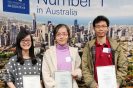
Học sinh của Công ty Đức Anh nhận học bổng 60.000 AUD tại Đại học Melbourne- ĐH số 1 tại Úc
Đại học Melbourne mới đây đã tổ chức lễ tuyên dương thành tích học tập của những sinh viên quốc tế nhận được Học bổng chương trình Cử nhân của…
Học sinh của Công ty Đức Anh nhận học bổng 60.000 AUD tại Đại học Melbourne- ĐH số 1 tại Úc
Trần Trọng Nhân- học sinh của công ty Đức Anh- đến từ trường phổ thông năng khiếu ĐHQG TP.HCM cùng 2 học sinh Việt Nam khác là Trần Phương Nga (Trường PTTH chuyên Lê Hồng Phong) và Đỗ Khánh Hiền (Trường PTTH chuyên Hà Nội-Amsterdam) đã nhận được các suất học bổng trị giá 60.000 AUD/người.